Vector baselines and host behavior
Most security monitoring focuses on what happened, such as a failed login, a new admin, or a suspicious process. That approach is useful, but many strong warning signs do not come from one event. They come from a change in how a host behaves over time. When normal behavior starts to shift, that is often where analysts first see a real problem forming.
Vector baselines solve this by learning the usual shape of activity for each host and then detecting when that shape changes. Instead of writing and tuning many static thresholds, baselines let the system learn what is typical for each host or device.
When current behavior is statistically far from that learned normal, the baseline creates a signal or a complex event, that is visible in the Discover section.
Use case for vectors
Every Windows machine produces a stream of event codes for logons, process creation, service activity, and network related operations. Over time, each host develops a recognizable pattern. A workstation at Monday 10 AM usually behaves like previous Monday mornings, while Sunday night on the same workstation looks very different. This recurring profile acts like a behavioral fingerprint.
If that profile changes sharply in the same context, for example same host and similar time slot, something meaningful may have changed as well. It can be malware execution, credential misuse, lateral movement, or an operational misconfiguration. Vector baselines turn this intuition into a measurable distance from expected behavior, thus detecting anomalies in this case.
Vectors are not just counts
A single hourly count of events is too coarse because it cannot distinguish many logons from many process launches. Vector baselines use a vector where each dimension corresponds to an event code and each value represents how many times that code appeared in the hour. This gives a richer representation of activity. Different mixes produce different vector shapes, even when total volume is similar.
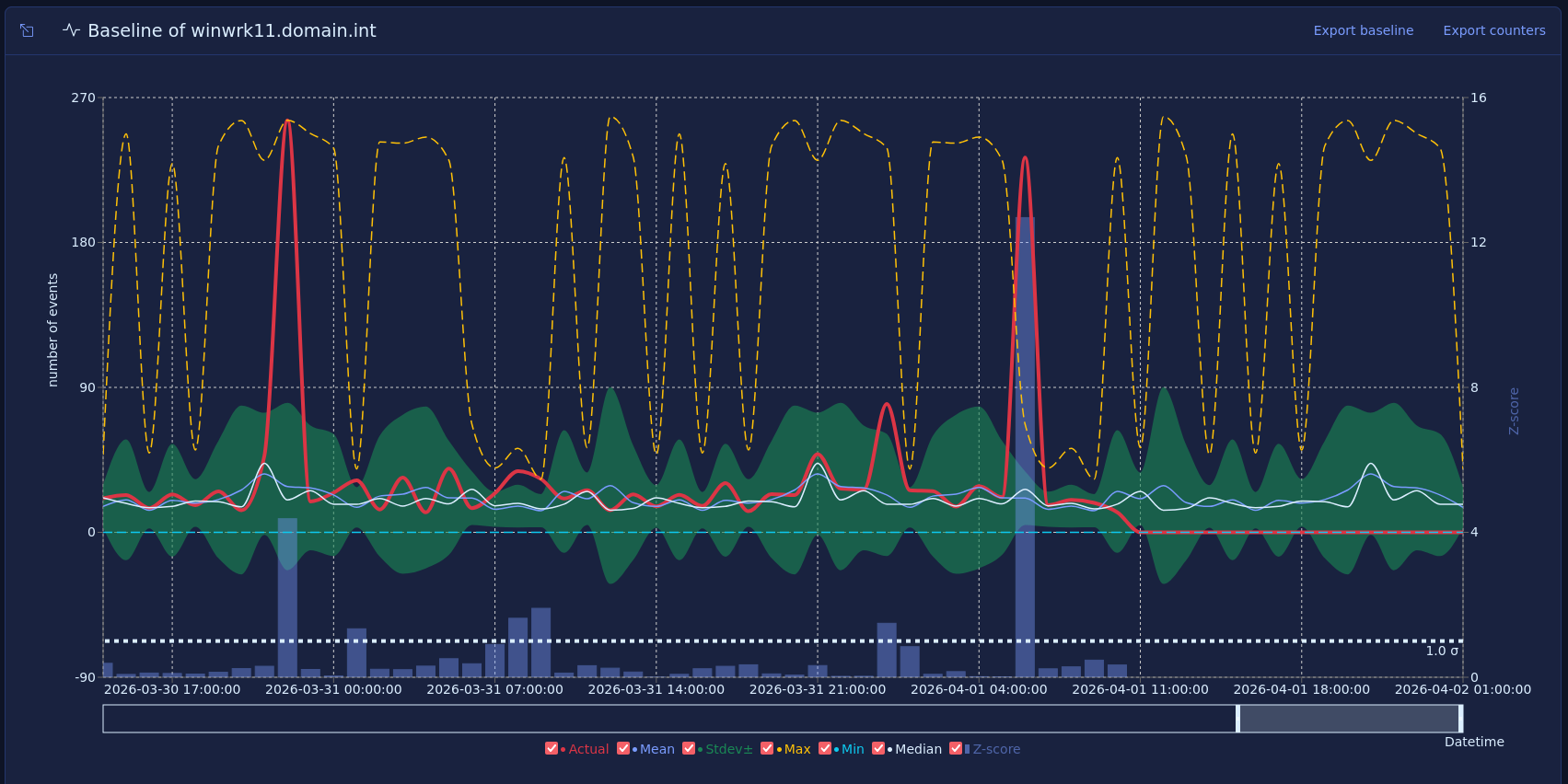
The system then derives a compact summary from the vector and learns the expected value and variability for each host in each time context. If the current value moves far enough away from that baseline, for example several standard deviations, the hour is marked as anomalous. In practice, this gives you a statistically grounded signal instead of a hard coded threshold.
Workdays, weekends, holidays
Normal behavior is not one universal value. A workday morning, a weekend evening, and a holiday can all have different traffic patterns. For this reason, separate baselines are learned for workdays, weekends, and holidays. This significantly reduces false positives because the model compares behavior to the right context instead of forcing one global expectation.
Benefits of vector baselines
In day to day operations, this approach gives each machine its own context aware notion of normal activity. It removes much of the manual threshold tuning that usually slows down rule maintenance in large environments. It also gives analysts a simple interpretation layer. The analyst can ask how unusual the current hour is, usually through a sigma or Z score, and then decide how aggressively to respond.
It is important to treat vector baseline output as a high quality signal, not as a final verdict. Teams usually get the best results when they combine this signal with other detections. For example, an unusual host behavior signal combined with suspicious authentication events typically gives much higher confidence than either signal alone.
Vector baselines are thus especially useful for compromised account scenarios, suspicious host behavior, and lateral movement where the activity mix changes before a clear signature appears. They are also useful for detecting misuse or malware behavior that alters service, process, or network patterns in subtle but persistent ways.
Another practical benefit is visibility into drift. Hosts can change role over time because of infrastructure changes, maintenance, or deployment updates. With baseline based monitoring the analyst can see that shift, investigate it, and then decide whether to adapt policies or keep alerting on the change.
Conclusion
By learning expected behavior per host and per context such as event codes, vector baselines give a lightweight and adaptive way to surface meaningful deviations, often earlier than single event rules.
For full technical detail including configuration, weights, sigma thresholds, and integration into your detection pipeline, see Detecting user activity anomalies using event code vector baselines.